29 Retraining and Real-Time Learning
Markets move faster than models retrain. A new game launches and takes over a genre’s audience, an exchange changes its auction, a holiday weekend changes who’s playing, or a competitor changes how it bids. A model retrained once a day is always a little behind, and a model retrained once a week can be badly behind by the end of the week. Every DSP has to decide how fresh its models need to be, and what it’s willing to pay, in compute and in risk, to keep them that fresh.
“Real-time learning” is the phrase vendors use for the answer, and it means very different things depending on who’s using it. Some mean retraining every few hours. Some mean features that update within seconds. Some mean models that update themselves continuously. Some mean a business that gets better with more data. This chapter separates them, because they have very different costs and risks.
In this chapter, we will look at frequent retraining and real-time features, separate the five things real-time learning can mean, and cover the risks of learning fast, with guards against them. We then handle delayed feedback when models retrain every few hours, and build shared state for real-time features on the counter store from Part II.
Frequent Retraining and Real-Time Features
The retraining thread has run through the book: daily in crawl, a few times a day in walk, and near-continuous in run. The leading platforms describe the far end of it. Moloco describes deploying models as often as every two hours, with real-time features that update the next prediction as soon as a user sees an ad or a competitor changes a bid.1 Liftoff describes training hundreds of models a day on over a petabyte of new data.2 Meta describes its GEM foundation model as training continuously.3
A DSP with the architecture from Chapter 27 doesn’t retrain everything at the same pace. It has three cadences, as Figure 29.1 shows:
- Transformer pretraining trains on non-attributed events from every source, and is retrained weekly to monthly. Its device states are recomputed daily in batch, and refreshed for devices with new events, as in Chapter 28.
- The co-trained towers and heads train on attributed impressions and are retrained weekly. They produce the ad and publisher vectors and the dot products.
- LightGBM trains on the last few days of attributed impressions and is retrained every few hours. It produces the click and install probabilities the bidder uses.
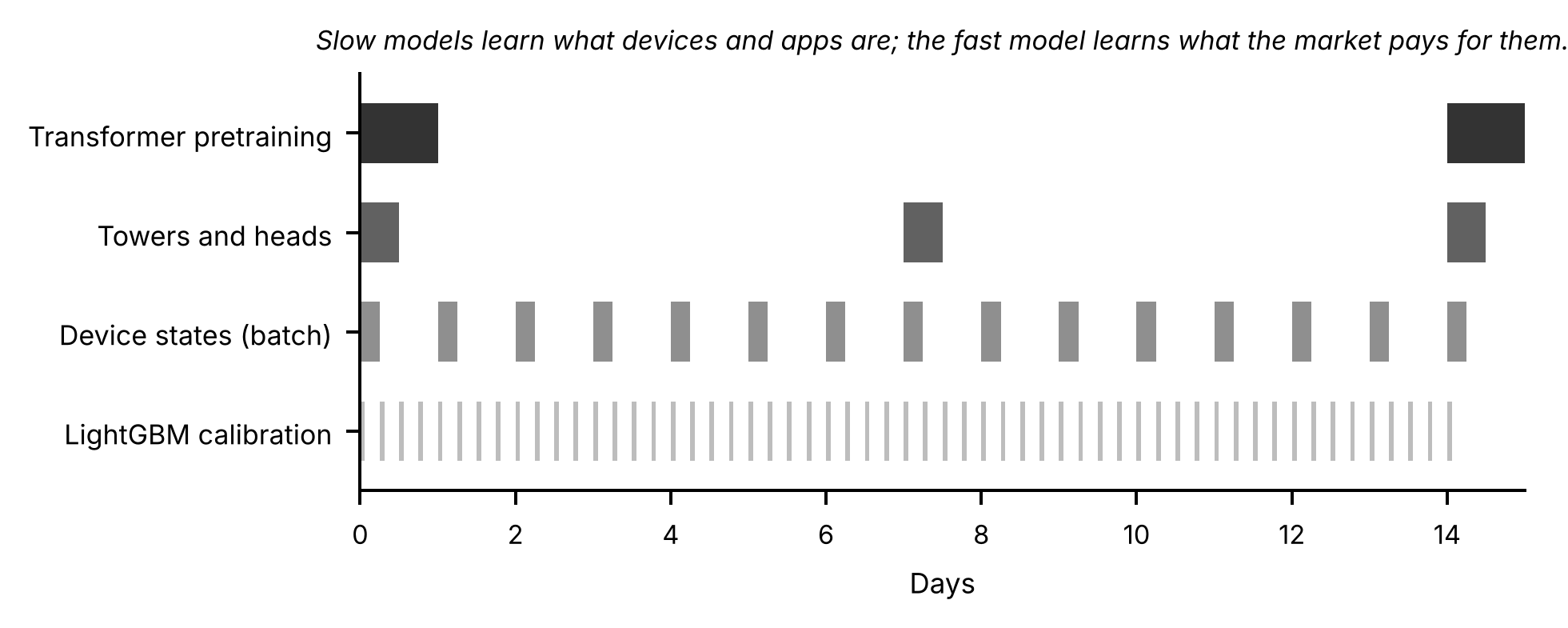
The slow models learn what devices and apps are, and the fast model learns what the current market pays for them. That split is what makes frequent retraining affordable: only the small model retrains every few hours, and the expensive ones retrain when the world changes enough to matter. It also means “how often should we retrain?” has three answers, one per layer, each found the same way: train the layer at several cadences on the simulator or on replayed data, and see where the gain from fresher models stops paying for the compute. In my post on real-time ML systems, I describe the same trade-off from the serving side, as a range from features precomputed in batch and stored in a NoSQL store to features computed from the request in real time, each with its own cost and freshness.4
Retraining every few hours is possible only when everything around it keeps up. The pipelines from Chapter 18 need to run end to end within the interval, validation and canaries need to be automated, since nobody can review a model every two hours, and the labels a model trains on need to be as recent as the model. The last one is the hardest, as we’ll see below.
Real-Time Learning
It helps to separate the five things “real-time learning” can mean, because vendors use the phrase loosely:
- Frequent batch retraining, from daily to every few hours. Moloco says it retrains as new signals arrive and deploys as often as every two hours, and Liftoff says it trains hundreds of models a day on over a petabyte of new data.56
- Real-time features, updated within seconds of an impression or a win. The model doesn’t change, but its inputs do. Moloco describes features that update the next prediction as soon as a user sees an ad or a competitor changes a bid.7
- Fast-adapting layers on a slower model. The calibration multiplier \(\kappa\), per-campaign bias terms, the pacing multiplier \(\gamma\), and creative bandits absorb drift between retrains. This is the practical sweet spot for a DSP, and most of it was built in Parts II and III.
- Online training of the model itself, where the model’s weights update with each new example. FTRL logistic regression from Chapter 9 is the classic example,8 continuous training of large models such as GEM is the modern one,9 and libraries such as GoMLX can fine-tune a model in a Go service on win and loss feedback.10
- Self-improving systems, as described in earnings calls and product pages, where more advertisers and more data feed periodic model releases. AppLovin describes models that keep improving through periodic releases and more data, and Unity describes its Vector platform as self-learning and adaptive.1112 These are claims about results, not methods, and should be read that way.
For most DSPs, the order to invest in is the order above, starting from the third: fast-adapting layers first, then more frequent retraining, then real-time features, and online training of the model itself last.
The risks of learning fast. The faster a system learns, the faster bad data reaches it. In online learning, a burst of bad labels or a broken feature changes the model immediately, with no validation step in between. Unity has described rebuilding its earlier system after it ingested inaccurate customer data in 2022.13 In one incident I’ve written about, false-positive labels from a small experiment drove a clearing-price feature upward, which pushed bids up and fed back into the feature.14 The guards are the same at every level of speed:
- Filter outliers before they reach the model, such as segments whose label rates jump far beyond their history.
- Handle delayed labels, so recent examples aren’t treated as negatives.
- Bound updates, so no single interval can move the model or a multiplier more than a set amount.
- Roll back fast to the last scheduled model, with the automated rollback from Chapter 19.
Delayed Feedback with Frequent Retraining
In walk, we waited for each label’s window to close before training on it. Figure 29.2 shows why that’s expensive: click-through installs arrive within an hour or so, but view-through installs take most of a day, and first purchases within a D7 window keep arriving all week.
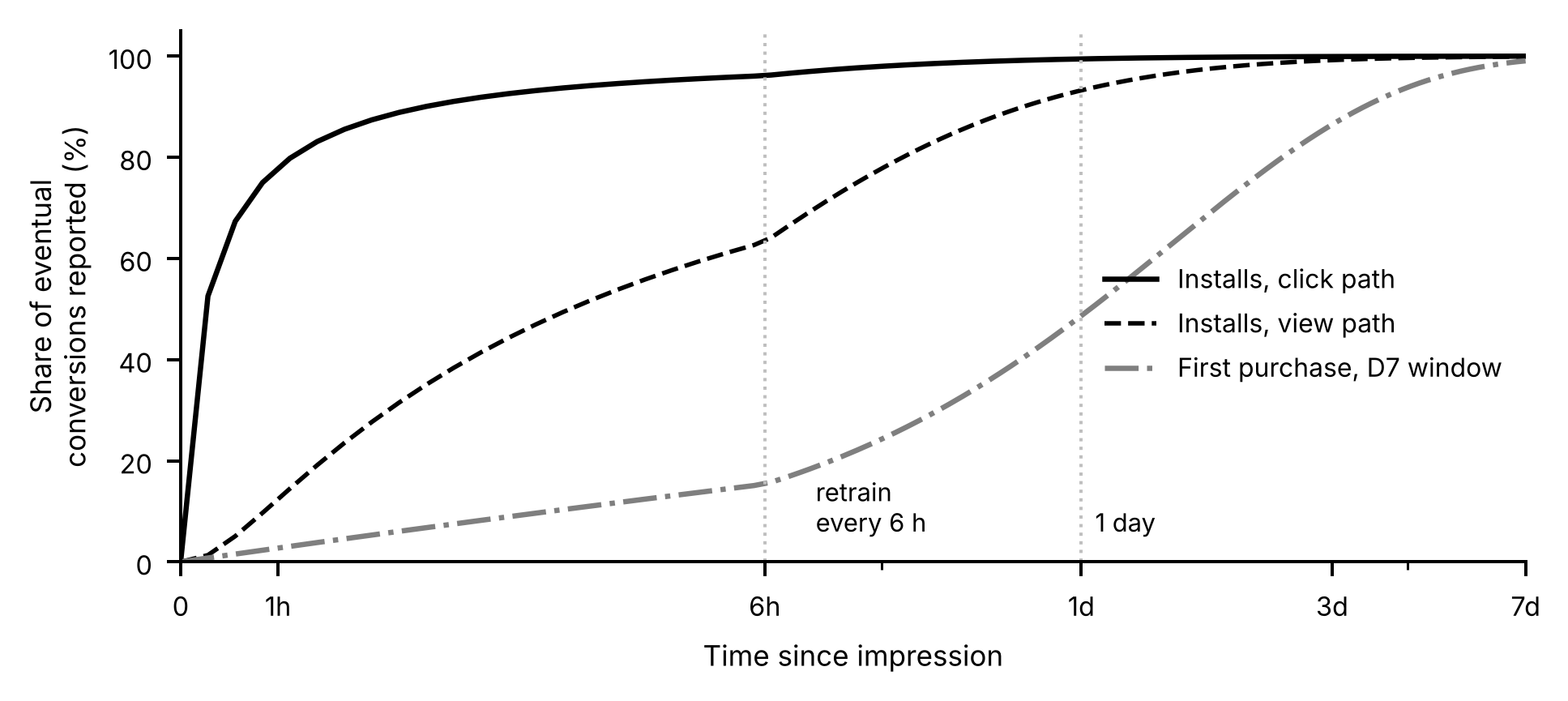
When models retrain every few hours, waiting a week for purchase labels throws away exactly the recent data that frequent retraining is for. But training on recent impressions without waiting means their installs and purchases haven’t arrived yet, so they look like negatives, and the model underpredicts.
Three published approaches correct for this:
- The delayed feedback model models the conversion and the delay together, so an impression without a conversion yet is treated as “not converted so far” rather than “not converted”.15
- Elapsed-time sampling (ES-DFM) corrects the training distribution for how long each example has been waiting, using importance weights.16
- Real negatives (DEFER) ingests examples first as unlabeled or fake negatives, and later ingests the real labels and real negatives, with a correction so the model stays unbiased.17
The simulator makes the bias easy to see, because it knows the true conversion rate. Train a model every few hours on recent impressions with naive labels, and its predictions fall below the true rate. Apply one of the corrections, and the gap closes.
Conclusion
In this chapter, we looked at keeping models current, with three cadences for the slow pretrained models, the co-trained towers, and the fast calibration layer. “Real-time learning” covers five different things: frequent retraining, real-time features, fast-adapting layers, online training, and claims about self-improving systems, and the fast-adapting layers built in Parts II and III are the practical place to start. Learning fast also spreads bad data fast, so outlier filters, delayed label handling, bounded updates, and fast rollback guard every level. When models retrain every few hours, delayed feedback corrections replace waiting for labels, and real-time features come from a shared counter store, logged as the bidder saw them.
Freshness matters most for predictions that move fastest, and the slowest labels belong to value. In the next chapter, we predict what an installed user will be worth.
Moloco, “Inside Moloco’s CARA: the AI that compounds,” Moloco blog, 2026, https://www.moloco.com/blog/inside-molocos-cara-the-ai-that-compounds↩︎
“How Liftoff improved conversion performance and reduced infrastructure costs with Cortex using AWS Graviton,” AWS for Industries blog, March 31, 2026, https://aws.amazon.com/blogs/industries/liftoff-improved-conversion-performance-and-reduced-infrastructure-costs-with-cortex-using-aws-graviton↩︎
Huayu Li, Xiaoyi Liu, Jade Nie, et al., “Meta’s Generative Ads Model (GEM): The Central Brain Accelerating Ads Recommendation AI Innovation,” Engineering at Meta, November 10, 2025, https://engineering.fb.com/2025/11/10/ml-applications/metas-generative-ads-model-gem-the-central-brain-accelerating-ads-recommendation-ai-innovation/↩︎
Ben Weber, “Approaches for Building Real-Time ML Systems,” Towards Data Science, September 2021, https://medium.com/data-science/approaches-for-building-real-time-ml-systems-79ea0e340269↩︎
Moloco, “Inside Moloco’s CARA: the AI that compounds,” Moloco blog, 2026, https://www.moloco.com/blog/inside-molocos-cara-the-ai-that-compounds↩︎
“How Liftoff improved conversion performance and reduced infrastructure costs with Cortex using AWS Graviton,” AWS for Industries blog, March 31, 2026, https://aws.amazon.com/blogs/industries/liftoff-improved-conversion-performance-and-reduced-infrastructure-costs-with-cortex-using-aws-graviton↩︎
Moloco, “Inside Moloco’s CARA: the AI that compounds,” Moloco blog, 2026, https://www.moloco.com/blog/inside-molocos-cara-the-ai-that-compounds↩︎
H. Brendan McMahan et al., “Ad Click Prediction: a View from the Trenches,” KDD, 2013, https://research.google/pubs/ad-click-prediction-a-view-from-the-trenches/↩︎
Huayu Li, Xiaoyi Liu, Jade Nie, et al., “Meta’s Generative Ads Model (GEM): The Central Brain Accelerating Ads Recommendation AI Innovation,” Engineering at Meta, November 10, 2025, https://engineering.fb.com/2025/11/10/ml-applications/metas-generative-ads-model-gem-the-central-brain-accelerating-ads-recommendation-ai-innovation/↩︎
Ben Weber, “Options for ML Serving with Golang,” Medium, May 7, 2026, https://medium.com/@bgweber/options-for-ml-serving-with-golang-3b1afa3a6182↩︎
AppLovin, Q1 2026 earnings call transcript, May 6, 2026, via The Motley Fool, https://www.fool.com/earnings/call-transcripts/2026/05/07/applovin-app-q1-2026-earnings-transcript↩︎
Allison Schiff, “Unity’s AI Ad Platform Is Out Of Beta After A Complete Rebuild,” AdExchanger, May 7, 2025, https://adexchanger.com/gaming/unitys-ai-ad-platform-is-out-of-beta-after-a-complete-rebuild/↩︎
Allison Schiff, “Unity’s AI Ad Platform Is Out Of Beta After A Complete Rebuild,” AdExchanger, May 7, 2025, https://adexchanger.com/gaming/unitys-ai-ad-platform-is-out-of-beta-after-a-complete-rebuild/↩︎
Ben Weber, “Machine Learning Incidents in AdTech,” Towards Data Science, January 29, 2025, https://medium.com/data-science/machine-learning-incidents-in-adtech-e3f48d858054↩︎
Olivier Chapelle, “Modeling Delayed Feedback in Display Advertising,” KDD, 2014.↩︎
Jia-Qi Yang et al., “Capturing Delayed Feedback in Conversion Rate Prediction via Elapsed-Time Sampling,” AAAI, 2021, https://arxiv.org/abs/2012.03245↩︎
Siyu Gu et al., “Real Negatives Matter: Continuous Training with Real Negatives for Delayed Feedback Modeling,” KDD, 2021, https://arxiv.org/abs/2104.14121↩︎