1 Introduction
Every time someone opens a free mobile game and an ad appears between levels, an auction has just taken place. In a fraction of a second, an exchange asked many bidders whether they wanted to show an ad to that user, and machine learning models decided which ad to show and how much to pay for it. This happens billions of times per day, and it’s how most mobile games and apps find new users.
This book is about building the machine learning systems that make those decisions inside a demand side platform (DSP), the system that bids on ad impressions on behalf of advertisers. In this chapter, we’ll look at why apps advertise, how the market is organized, how a DSP turns model predictions into a price, and why that makes ML in ad tech different from ML in most other domains.
We’ll follow two fictional games through Part I. Gem Garden is a free match-3 game that earns most of its money by showing ads to its players. Cozy Farm Tycoon, from a mid-sized studio called Cozy Games, is a farming game that wants to grow on Android in the US, and buys new players through a DSP. Over the next three chapters, an ad opportunity in Gem Garden becomes an auction, the auction becomes an impression for Cozy Farm Tycoon, and the impression becomes an install and a purchase. At the end of Chapter 4, we work through that same bid by the numbers.
Why Apps Advertise
Mobile advertising serves two goals that sit on opposite sides of the market. Publishers want to monetize their apps by showing ads to their users. Advertisers want to grow their apps by acquiring new users. Most mobile games do both: they earn revenue by showing ads to their own players, and they spend money on ads in other apps to find new players.
The process of paying to get new users to install an app is called user acquisition (UA). An app developer runs UA campaigns with the goal of earning more from the acquired users, through in-app purchases and in-app advertising, than it spent to acquire them. When that math works, UA becomes a growth engine: the developer can keep reinvesting revenue into buying more users, and scale a game’s audience far beyond what organic discovery would deliver. That’s how entirely new genres, such as hypercasual games, were able to grow.
Installs are tracked by a mobile measurement partner (MMP), a third party that the advertiser integrates into its app, such as AppsFlyer, Adjust, Singular, Kochava, or Branch. When a user installs the app, the MMP decides which ad, if any, should get credit for the install, and reports it back to the ad platform in a message called a postback. MMPs are the scoreboard of mobile advertising. If the MMP says a DSP drove 1,000 installs at the advertiser’s target cost, the advertiser is happy, whatever the DSP’s own logs say. For a DSP, postbacks are also the labels that its models learn from. We cover MMPs in Chapter 3.
For many years, Facebook was the dominant channel for getting app installs. It launched mobile app install ads in October 2012, and by the first quarter of 2013, about 3,800 advertisers had used them to drive more than 25 million installs.1 Since then, the channels for UA have diversified. Large self-attributing networks, often called walled gardens, such as Meta, Google, Apple, and TikTok, are still major channels. But a large share of UA spend now goes through programmatic channels, where software bids on individual ad impressions in real time. The system that does this bidding is the DSP. It receives requests for ad impressions from ad exchanges, decides which of its advertisers’ campaigns to show, predicts how valuable the impression is to that advertiser, and submits a bid.
Games and the Business of Growth
Most large mobile game studios have central publishing teams, and user acquisition is one of their biggest responsibilities. You’ll often hear the term growth used for this work, with UA as one of several growth challenges alongside retention, monetization, and live operations. UA budgets are among the largest line items for a mobile game.
Ad tech has also helped to democratize game development. Rollic, a hypercasual publisher that Zynga acquired in 2020, works with independent studios, gives them its Elephant SDK for analytics and A/B testing, and uses the data to decide which games to put UA budget behind.2 3 A small team with a promising prototype can find out quickly whether its game can acquire players at a cost that pays off.
Games are also a good training ground for ML in advertising, because studios measure campaigns on more than installs. They care about whether new players come back the next day, whether they make a purchase in their first week, and whether a group of players pays back the campaign within a target window. Hypercasual games add a different flavor: they earn most of their revenue from ads rather than purchases, so a new player’s value depends on how many ads they’ll watch. We cover these goal types in Chapter 4.
ROAS and Lifetime Value
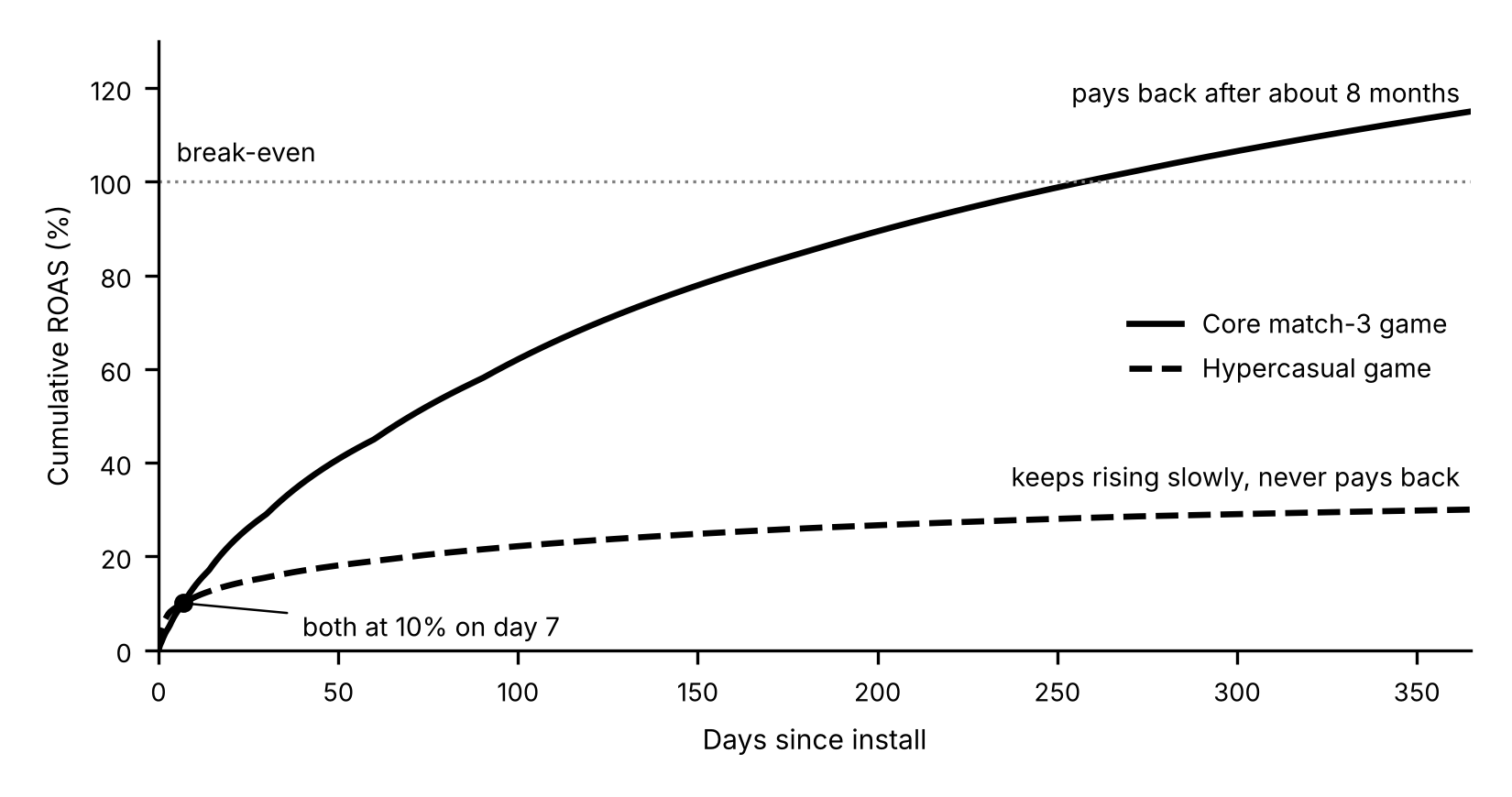
Studios judge a return on ad spend (ROAS) number against the lifetime value (LTV) curve of their game: how much revenue a group of new players, called a cohort, earns over its whole life, most of which arrives months after the install. That’s why the same D7 ROAS can be good or bad. A D7 ROAS of 10% is a strong result for a core match-3 game whose players keep spending for years, and a poor one for a hypercasual game that earns most of its revenue from ads in the first few days. Figure 1.1 shows the difference.
Long-term LTV modeling is usually the studio’s job, not the DSP’s. The studio has the full revenue history of its players and knows how its curves have behaved across past cohorts. A common approach is survival analysis, which models how long players keep playing. It handles the awkward fact that most players in a recent cohort are still active, so you don’t yet know when they’ll stop, and mobile game studios have published work using it to predict when players will churn.4 It’s common for a large studio to share the result with its DSPs, as a multiplier from the revenue it observes at day 7 to the revenue it expects over a year, and to set its D7 targets with that multiplier in mind.5 The DSP’s job is to deliver against the early target the studio sets. The catch is that players who spend in their first week aren’t always the ones who spend the most over a year, which we come back to when we build value models.
Some studios go a step further and use the term boosted LTV: a projected one-year LTV for recent installs, built from the studio’s own curves and early signals such as day-1 retention and first-week spend. A boosted LTV gives the studio an answer about a cohort months before the revenue arrives. When a studio has one, it often judges its DSPs on the boosted number more than on the D7 LTV that the MMP reports, since the boosted number is closer to what the studio cares about. For the DSP, this means two campaigns with the same D7 ROAS can be judged very differently, and the number it’s measured on can change after the fact when the studio updates its projections. The DSP never sees the studio’s model, so the best it can do is learn which early signals the studio rewards, which is part of what the value models in Chapter 30 are for.
User Acquisition and Retargeting
This book focuses on user acquisition rather than retargeting, where an advertiser pays to re-engage people who already have its app. Some platforms specialize in retargeting. For example, RZR, formerly Aarki, ranked second worldwide in iOS gaming remarketing in the 2026 AppsFlyer Performance Index, behind only Meta.6 The dynamics differ: when retargeting, the advertiser often knows how the user behaved in the app, while a DSP looking for new installs has to predict the behavior of someone who has never opened it. Many of the techniques in this book apply to both, but the examples focus on acquiring new players.
The Market
In the Preface, we looked at the scale of advertising across the internet. Mobile apps are a large and growing part of it. Each year, AppsFlyer publishes a performance index that ranks the media sources app marketers spend on, based on billions of attributed installs. In the 2026 edition, the top-ranked networks globally were AppLovin on iOS gaming, Google Ads on Android gaming and Android non-gaming, and Apple Ads on iOS non-gaming.7 These media sources, along with Meta and TikTok, capture a large share of the money app developers spend to acquire users.
AppLovin is the clearest example of how large a mobile-first ad tech company can become. Its full year revenue for 2025 reached $5.48 billion, up 70% from the prior year, with an adjusted EBITDA margin of 82%.8 Those margins are closer to a software company than to a media business, and they reflect how much of the work is done by machine learning rather than by people. Liftoff, formed through the 2021 merger of Liftoff and Vungle, went public in June 2026 at a valuation of $3.83 billion, reporting 878 demand-side customers.9 Moloco, still privately held, states that its models make nearly 8 million predictions per second across 600 billion bid requests each day.10
The industry has also been shaped by some of the largest deals in games. Microsoft’s $68.7 billion acquisition of Activision Blizzard in 2023 brought one of the largest mobile game portfolios into Microsoft, along with the group that sells advertising across its games.11 Zynga acquired Chartboost, a platform with a DSP, a supply side platform, and mediation, in 2021, and was itself acquired by Take-Two a year later.12 13 Unity merged with ironSource in 2022, combining a game engine with a mediation and monetization platform.14 Beyond these, there are many other players, including InMobi, Appodeal, Bigabid, and RZR, along with dozens of smaller DSPs, exchanges, and ad networks, some specialized by region, vertical, or part of the stack.
The Three Pillars of Ad Tech
It helps to have a mental model of how the industry is organized. Mobile ad tech can be thought of as three pillars:
- The demand side: advertisers and the platforms that buy on their behalf, including DSPs and ad networks. This is where user acquisition happens.
- The supply side: publishers and the platforms that sell their ad inventory, including supply side platforms (SSPs) and mediation platforms. Mediation decides which ad source gets to fill an ad slot in an app.
- Exchanges: the marketplaces in the middle that connect supply and demand, run auctions, and pass requests and bids between the two sides.
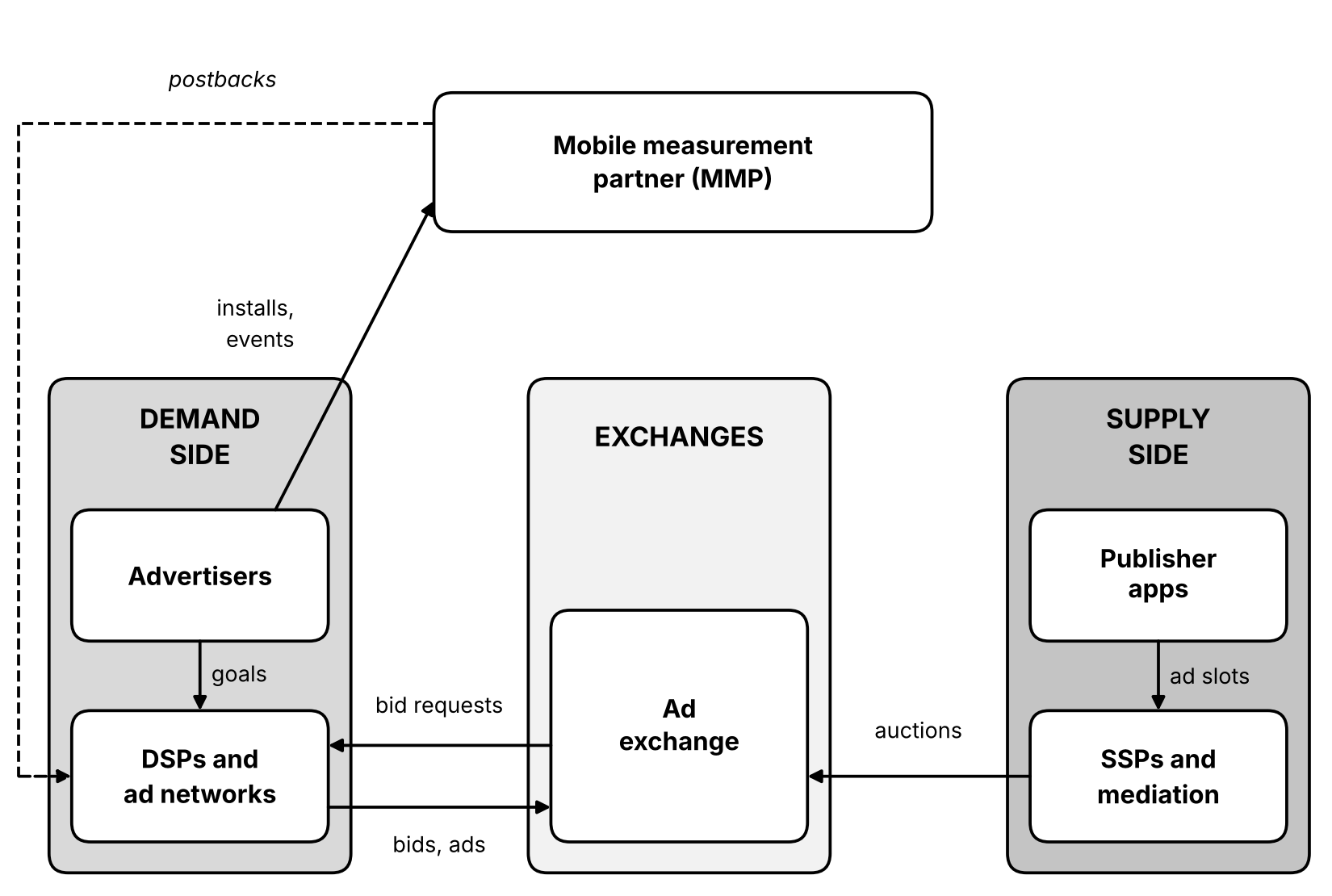
Figure 1.2 shows how the pillars connect. Publisher apps send ad requests to their mediation platform or SSP, which offers the ad slot to one or more exchanges. Each exchange sends bid requests to DSPs and ad networks, which bid on behalf of advertisers. Alongside the auction, the advertiser’s MMP attributes installs and in-app events, and sends postbacks to the demand platform that gets credit.
Many companies build products for more than one pillar. Chartboost ran a DSP, an SSP, and mediation as one platform, and AppLovin went further when it acquired the MMP Adjust in 2021.15 Owning more of the stack gives a company more data and more control over the auction, which is one reason consolidation has been such a strong force in this industry.
From Fixed Prices to Machine-Driven Auctions
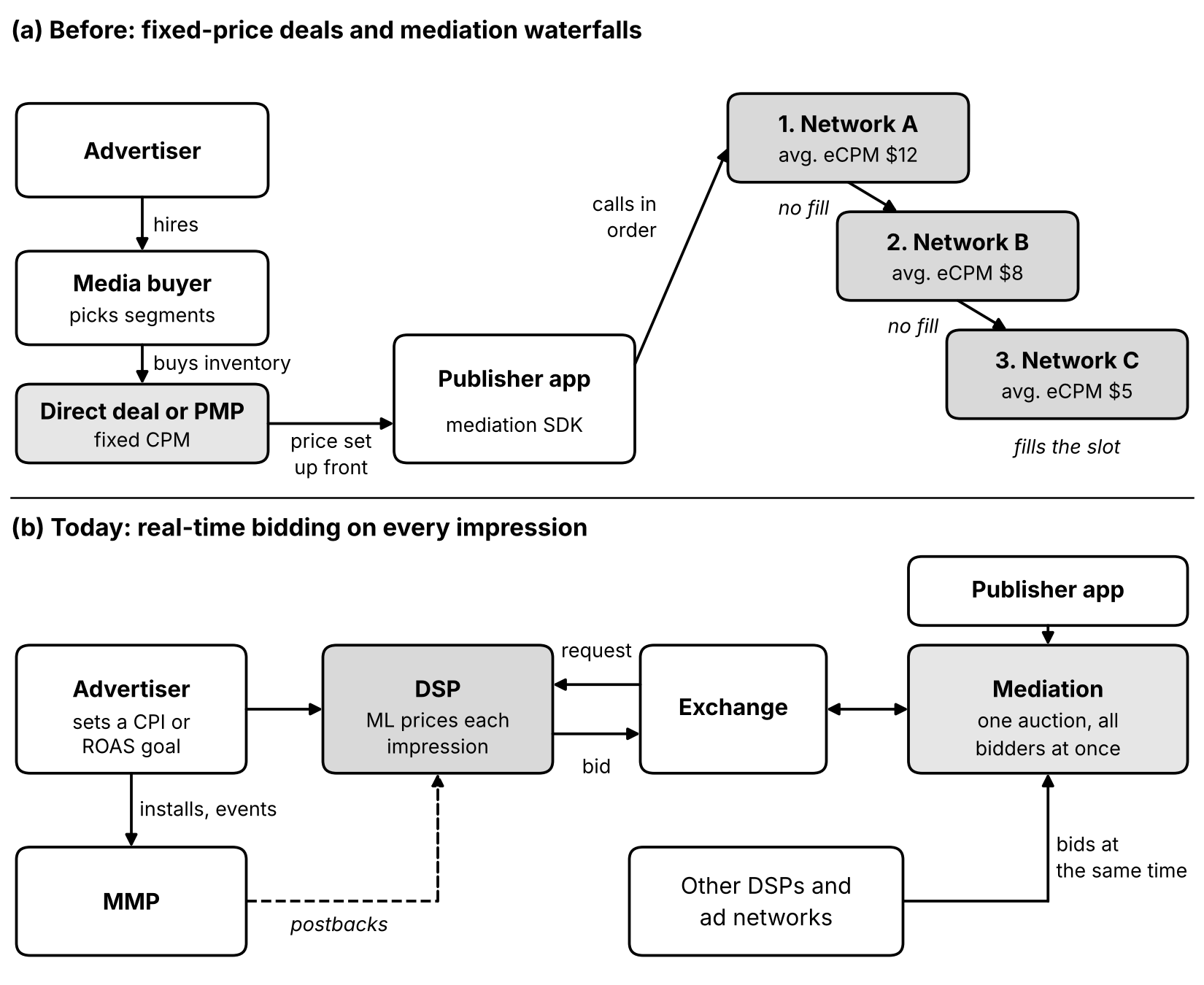
Mobile advertising wasn’t always a world of ML models pricing auctions in real time. Early mobile ad buying looked more like TV advertising. Inventory was sold through direct deals and private marketplaces (PMPs) at fixed CPMs, the price paid per thousand impressions, and targeting was limited to broad demographics and audience segments. A media buyer decided who to target, and the price was negotiated up front.
The sell side went through a similar shift. Publishers monetized through a mediation waterfall, a ranked list of ad networks that the app called one after another, highest historical price first, until one of them filled the ad slot.16 Each network got its chance based on what it had paid on average in the past, not on what that impression was worth. In-app bidding replaced this by letting demand sources bid on each impression at the same time. Facebook began testing bidding on Audience Network in 2017, Google launched open bidding for AdMob in 2018, and in October 2020, Facebook announced that Audience Network would become bidding-only.17 With mediation platforms running auctions, every impression became something a DSP could price individually. Figure 1.3 contrasts the two models.
MMPs made the next step possible. Once impressions, clicks, and installs could be tracked at the level of individual events, ad platforms could measure which impressions led to installs and revenue. That unlocked an arms race: platforms that could predict which impressions would convert could pay more for the good ones and less for the bad ones. Instead of a person choosing segments, the bidder predicts how much value an ad for a specific app on a specific device will deliver, and bids accordingly.
Advertisers’ goals changed along with this. Rather than buying impressions at a fixed price, advertisers now set performance goals, such as a target cost per install (CPI) or a target return on ad spend after seven days (D7 ROAS), and the DSP decides which impressions to buy and how much to pay for each. The market is now very competitive. A new DSP has to match the performance of platforms that have been refining their models for years: predicting which devices will install which apps, pricing bids to win the right auctions without overpaying, and keeping up with competitors whose strategies keep changing.
Ad Formats
Mobile ads come in several formats, and the format affects both how users respond and what a DSP needs to predict. Figure 1.4 shows three common formats in a fictional match-3 game.
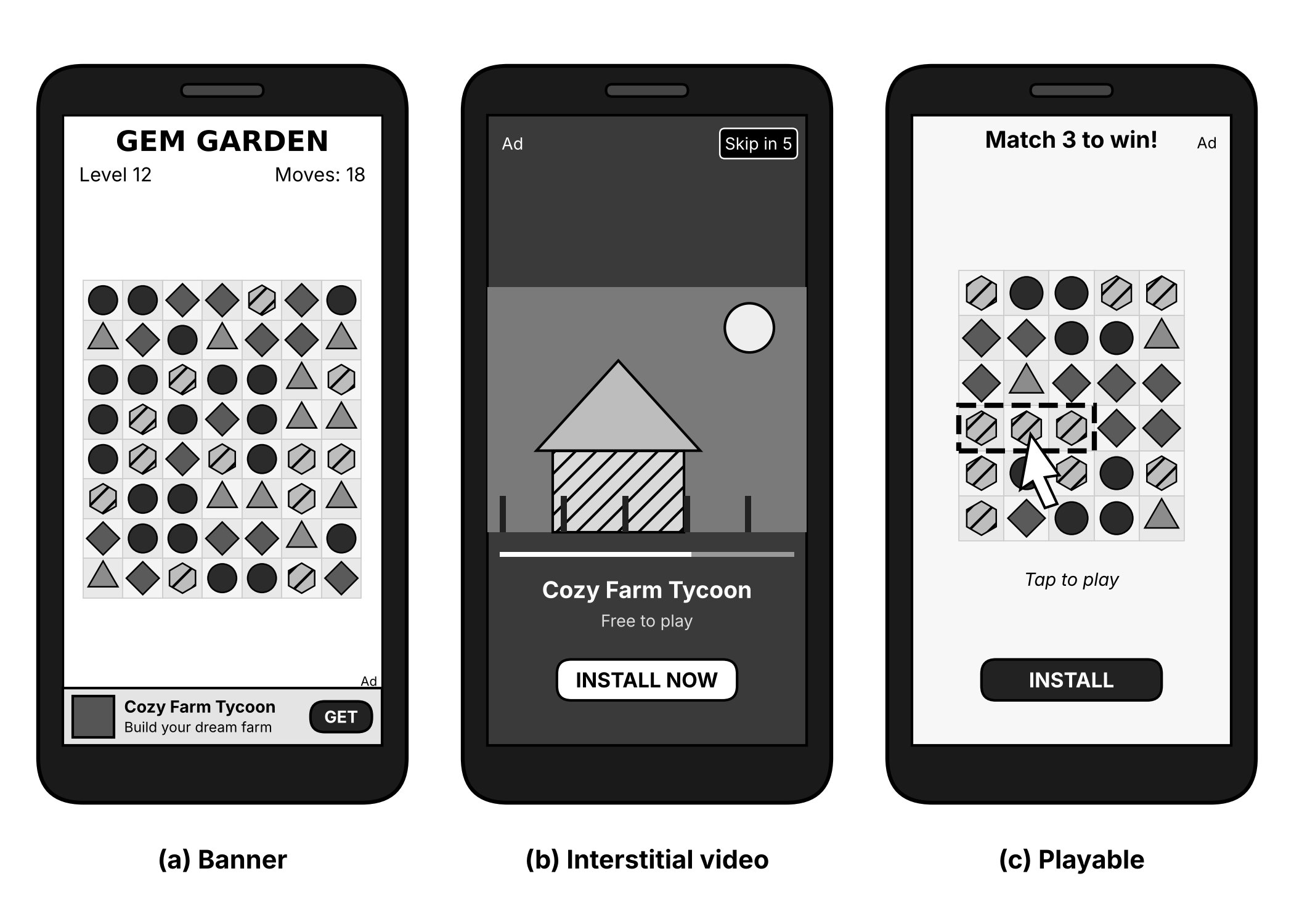
- Banners are small ads along the edge of the screen. They’re cheap and plentiful, but get little attention and convert at low rates.
- Interstitials are full-screen ads at natural breaks, such as between levels. Video interstitials are one of the most common UA formats, often followed by an end card with an install button.
- Rewarded videos are videos the user chooses to watch in exchange for an in-game reward, such as extra moves. Because the user opts in, they tend to get high completion rates.
- Playables are small interactive ads that let the user try the game before installing it, and they tend to attract players who keep playing.
What a DSP Does
Here’s the life of a single impression from the DSP’s point of view. We keep it light here, and fill in the details over the rest of Part I.
- A request arrives. A user opens a game, and the game’s SDK asks its mediation platform to fill an ad slot. An exchange sends a bid request to the DSP and many other bidders at the same time, using a standard called OpenRTB, maintained by the IAB Tech Lab.18 The request describes the app, the ad slot, the device, and the auction’s rules, such as the minimum price and the time limit.
- The DSP decides whether to bid. It looks up what it knows about the device, filters out campaigns that aren’t eligible for this request, and predicts how likely the user is to click, install, and spend for each remaining campaign.
- The DSP decides what to show and how much to pay. It picks the campaign and creative with the highest expected value, converts its predictions into a price, and sends a bid response, all within a time budget measured in milliseconds.
- The exchange runs the auction. If the DSP’s bid wins, the exchange notifies the DSP and the ad is shown in the app.
- The DSP waits. Over the following hours and days, the MMP sends postbacks for installs and in-app events. Only then does the DSP learn whether its decision was a good one.
A key input to these decisions is the device profile: what the DSP knows about a device from past interactions, such as which apps it has been seen in, which ads it has been shown, and whether it has installed or paid in other games. Profiles depend on a stable device identifier, and this is where the two mobile platforms differ the most. On Android, the advertising ID is widely available, and profiles can be rich. On iOS, most users decline tracking under Apple’s App Tracking Transparency framework, so many requests arrive with no profile at all.19 This book focuses on Android, where a DSP can see the most, and covers working with thinner signals in Chapter 38.
Every Prediction Has a Price
Every prediction in a DSP has a price attached to it. When a model overestimates the chance that a user will install an app, the bidder overpays. When it underestimates that chance, the bidder loses auctions it should have won. Small errors that would be harmless in many other ML applications turn into real money when they’re repeated across millions of requests per second.
Let’s make this concrete. A common metric in mobile UA is IPM, installs per thousand impressions. Suppose an advertiser is willing to pay $5 per install. If a DSP knew that a set of impressions had an IPM of 1, it could pay up to $5 per thousand impressions and still deliver installs at the target cost. Now suppose the DSP’s model predicts an IPM of 2 for those impressions, but the MMP measures an actual IPM of just 1. In a first-price auction, where the winner pays what it bids, the DSP pays up to twice what the impressions are worth. The model may rank impressions perfectly well and still lose money, because its predicted probabilities are too high. This is why calibration, getting the predicted probabilities right and not just their order, matters as much as ranking in ad tech. Digital Turbine’s DSP team makes the same point about install rate models: a well-calibrated model is what informs bidding decisions.20
A DSP turns its predictions into a price by multiplying the chance of the outcome the advertiser wants, such as an install, by what the advertiser will pay for it, keeping a margin for itself, and expressing the result as a price per thousand impressions. The formulas are simple. The hard part is the probabilities, because every term other than the advertiser’s target and the margin is a model prediction. We work through the formulas, and how advertisers pay DSPs, in Chapter 4.
Key Metrics
Mobile ad tech runs on a small set of metrics, and different people watch different ones. Table 1.1 collects them in one place.
| Metric | How it’s calculated | Who watches it |
|---|---|---|
| CPM | Cost per 1,000 impressions | Advertisers and DSPs, as the price of media |
| eCPM | Publisher revenue per 1,000 impressions | Publishers and mediation platforms |
| Fill rate | Ad requests filled ÷ ad requests | Publishers |
| Win rate | Auctions won ÷ bids made | DSPs |
| Clear rate | Billable impressions ÷ auctions won | DSPs |
| CTR | Clicks ÷ impressions | DSPs and creative teams |
| IPM | Installs per 1,000 impressions | UA teams and DSPs |
| CPI | Spend ÷ installs | UA teams |
| CPA | Spend ÷ a target in-app event, such as a first purchase | UA teams |
| Retention (D1, D7) | Share of new players who come back on day 1 or day 7 | UA and game teams |
| ROAS (D7, D30) | Cohort revenue by day 7 or 30 ÷ spend | UA and finance teams |
| LTV | Total revenue a player generates over their lifetime, usually predicted by the studio | Studios, which share targets with DSPs |
| Payback period | Days until a cohort’s revenue equals its cost | Finance teams |
| Incremental CPI | Spend ÷ installs that wouldn’t have happened without the ads | UA teams that run holdout tests |
Credit Versus Impact
There’s a catch in how this market keeps score. A typical game advertiser buys from Meta, Google, Apple, TikTok, a few ad networks, and a few DSPs, all at once. The same player might see ads from several of them in a week, and might have installed the game anyway, after a store search, a friend’s recommendation, or a spot on the top charts. Under last-touch attribution, the whole install goes to whichever platform touched the player last. That rewards being last, not being useful.
This makes the system congested. Every platform learns the same lesson from its data: the devices most likely to install are the ones that are already close to installing, such as heavy players of similar games. So every platform bids for the same devices, the price of reaching them goes up, and much of the money spent moves credit between platforms rather than creating new players. A DSP can look excellent in the MMP’s reports while adding very little.
The alternative is to measure incrementality: the installs that wouldn’t have happened without the ad. If I were starting a DSP today, incremental value is the offering I would build the product around. It’s harder to copy than a slightly better attribution model, it’s what an advertiser’s budget is really paying for, and as more advertisers run holdout tests that pause spend and measure what changes, platforms that only collect credit lose their budgets.
Here’s the idea in its simplest form: bid on the lift, not the likelihood. Take two devices. Device A is a heavy player of farming games, with a 5% chance of installing Cozy Farm Tycoon if it sees our ad, and a 4% chance if it doesn’t. Device B mostly plays puzzle games, with a 2% chance of installing if it sees our ad, and 0.5% if it doesn’t. A model trained on attributed installs prefers device A, because 5% is more than 2%. But our ad only adds 1 point for device A, and 1.5 points for device B. Bidding on the lift sends the budget to device B, where the ad actually changes what happens.
You never see both outcomes for the same device, though, so a DSP has to estimate the “without our ad” number from randomized holdouts. Each of the next three chapters adds a piece: why the auction is crowded, why attribution can’t tell credit from impact, and how a DSP can price and report on incremental value.
Why ML in Ad Tech Is Different
If you’ve built ML systems in other domains, much of the modeling in this book will look familiar. What makes ad tech different are the constraints around the models, which shape every later chapter:
- Latency: the DSP has milliseconds to respond to each bid request, including the time to look up the device profile, score every candidate campaign, and build the response.
- Scale: a DSP can receive millions of bid requests per second, and its logs grow by billions of rows per day.
- Money on every prediction: as the IPM example shows, calibration matters as much as ranking. A model that’s wrong in a consistent direction costs money on every bid.
- Sparse and delayed labels: most impressions never lead to a click, and most clicks never lead to an install. The installs and purchases that do happen are reported by the MMP hours or days later.
- Feedback loops: a DSP only learns from the auctions it wins. Its models decide which impressions it buys, and those impressions become its training data.
- Other players shape the data: the labels a DSP learns from are also shaped by every other platform in the market, including some that bend the attribution rules in their favor.
A Market That Keeps Changing
The mobile ad tech market never stands still. As we saw in the Preface, the mix of advertisers keeps shifting, from games to shopping, streaming, finance, and most recently prediction markets and sports betting, and a well-built ML system can learn a new vertical much faster than a team can hand-tune rules for it.
Consolidation also changes the market, by unlocking flywheels that smaller players can’t match. A company that runs an exchange sees far more bid requests than any single DSP, along with the prices other bidders paid, which shows what it takes to win an auction. AppLovin is a good example of how far this can go. After building a large data asset across its mediation platform, exchange, and measurement business, it sold its mobile games business to Tripledot Studios in 2025.21 One way to read that sale is that once the advertising platform had data at that scale, owning game studios to feed it became less important.
The rules of the ecosystem change too. Apple’s App Tracking Transparency framework, launched with iOS 14.5 in April 2021, requires users to opt in before an app can access the device’s advertising ID, and most users decline.22 On Android, Google announced a Privacy Sandbox that was expected to replace the advertising ID, but in October 2025 it retired those technologies, so the advertising ID remains the main identifier on Android for now.23 DSPs shouldn’t build as if device identifiers will last forever.
What You Will Be Able to Build
The goal of this book is for you to be able to join an ad tech company and deliver a new model workflow inside a DSP, end to end. That means training, validating, and publishing a model, and then either writing a technical spec that a bidder engineering team can implement, or building the serving code yourself. After Part I, we build a working DSP with simple models first, and then improve each model, from simple and validated approaches to the state of the art.
Part I has no code. From Part II on, we build a reference DSP three times, at three levels of ambition. In Part II, the crawl stage, it’s a Go bidder with a logistic regression click model, CPC and a first CPI campaign, and the operations needed to spend real money. In Part III, the walk stage, it adds LightGBM models for click, install, purchase, and win rate, goal-based pricing, pacing, and incrementality reporting, with every change shipped through an A/B test. In Part IV, the run stage, it adds deep and sequence models served on CPU, one pricing equation for every goal, and learned pacing and selection.
The DSP runs against a companion bid simulator, a simulated market of devices, apps, exchanges, competing bidders, and an MMP. Because the market is simulated, we know the true click and install rates and the true lift of every impression, so we can check a model against the truth rather than only against attributed outcomes. You can trace a single bid through every step, watch the DSP on its web console as it bids, trains, and deploys models, and run it as it stands at the end of each part. From Part III, you can also replay a day of traffic through two versions of the bidder. The bidder is written in Go, and the training, validation, and publishing code in Python, with PySpark where the data is too large for a single machine. For each workflow, we present both a managed option on Google Cloud Platform and an open source option you can run on your own hardware.
This book covers the demand side of mobile programmatic advertising, with a focus on user acquisition for Android, and a universal model approach, where one model serves all campaigns for a platform. It covers the ML parts of the bidder in depth, along with enough of the surrounding engineering to wire them up. It doesn’t cover the infrastructure work of scaling a bidder to millions of requests per second, such as Kubernetes and deployment automation, or how to build the ad markup in a bid response.
Conclusion
Mobile ad tech is a large and competitive industry, and machine learning is at the center of it. Every bid a DSP submits depends on predictions: how likely a user is to click, to install, and to spend. Those predictions need to be well calibrated, because errors turn directly into overpaying or losing auctions, and they need to be made millions of times per second, within a few milliseconds each. And in a crowded market, the predictions that matter most are about what the ad changes, not just what the user would do anyway.
In the next chapter, we follow an ad opportunity in Gem Garden from the ad slot to the auction, and see how a DSP wins it, and why winning doesn’t always mean the ad is shown.
AdExchanger, “Facebook Mobile App Install Ads Capture Revenue, Drive Installs,” 2013.↩︎
PocketGamer.biz, “Hypercasual developer Rollic surpasses one billion downloads.” Rollic was founded in 2018 and acquired by Zynga in October 2020.↩︎
PocketGamer.biz, “Rollic, hyper-casual publishing star of 2019, launching its SDK equipped with analytic features powered by AI,” 2020.↩︎
For example, the game data science team at Silicon Studio, a Tokyo game developer, used survival ensembles to predict churn in its mobile game Age of Ishtaria: África Periáñez, Alain Saas, Anna Guitart, and Colin Magne, “Churn Prediction in Mobile Social Games: Towards a Complete Assessment Using Survival Ensembles,” IEEE DSAA 2016, https://arxiv.org/abs/1710.02264. The same team extended this to predict both the level at which players leave and their playtime until then: Paul Bertens, Anna Guitart, and África Periáñez, “Games and Big Data: A Scalable Multi-Dimensional Churn Prediction Model,” 2017, https://arxiv.org/abs/1710.02262. For a methods-focused introduction, see Markus Viljanen, Antti Airola, Jukka Heikkonen, and Tapio Pahikkala, “Playtime Measurement with Survival Analysis,” 2017, https://arxiv.org/abs/1701.02359.↩︎
For example, Vungle (now part of Liftoff) described a game developer whose D7 ROAS model used a historical multiplier between D7 and D365 revenue to measure the ongoing performance of its campaigns. Vungle, “Game developer meets ROAS goals with over 95% accurate LTV predictions,” https://vungle.com/success-story/game-developer-meets-roas-goals-with-over-95-percent-accurate-ltv-predictions/.↩︎
MarTech Edge, “RZR Global Ranks No. 2 in AppsFlyer’s iOS Gaming Remarketing Index,” October 29, 2026.↩︎
AppsFlyer, “Best mobile ad networks in 2026: The AppsFlyer Performance Index,” 2026. The 2026 edition analyzed 27.2 billion installs from nearly 25,000 apps across 57 media sources.↩︎
AppLovin, “AppLovin Announces Fourth Quarter and Full Year 2025 Financial Results,” February 11, 2026.↩︎
PocketGamer.biz, “Liftoff Mobile prices IPO at $3.83bn valuation,” June 2026.↩︎
“Korean-run unicorn Moloco wants to tear the garden walls down for peak ad performance,” July 2025, via Daum.↩︎
GeekWire, “Microsoft completes landmark Activision Blizzard acquisition,” October 13, 2023.↩︎
Zynga, “Zynga Closes Acquisition of Chartboost,” August 5, 2021. Zynga’s filings describe Chartboost as including “a demand side platform and supply side platform and mediation capabilities.”↩︎
Game World Observer, “Microsoft completes Activision Blizzard acquisition,” October 2023, which notes Take-Two’s $12.7 billion acquisition of Zynga as the second-largest deal in the games industry.↩︎
Unity, “Unity and ironSource merge to simplify launching and growing great mobile games,” November 2022.↩︎
AppLovin, Form S-1, 2021. AppLovin acquired Adjust on April 20, 2021, for a stated purchase price of $980 million.↩︎
PPC Land, “Mediation waterfall,” glossary entry.↩︎
AdExchanger, “Facebook Accelerates Plans To Go Bidding Only For Audience Network Due To Coming IDFA Changes,” October 2020.↩︎
PPC Land, “OpenRTB,” 2026.↩︎
Playwire, “App Advertising Privacy Changes: ATT Consent Management Explained for Publishers,” November 2026, citing Adjust benchmark data of an average opt-in rate around 35% in Q2 2025 and 38% in Q1 2026.↩︎
Digital Turbine, “Enhancing Install-Rate Prediction Models: Balancing Metrics and Offline Evaluation at DT-DSP,” https://www.digitalturbine.com/blog/enhancing-install-rate-prediction-models-balancing-metrics-and-offline-evaluation-at-dt-dsp↩︎
AppLovin, “AppLovin Completes Sale of Mobile Gaming Business to Tripledot Studios,” July 2025. The sale was for $400 million in cash and about 20% of Tripledot’s equity.↩︎
PPC Land, “App Tracking Transparency,” 2026.↩︎
PPC Land, “Chrome kills most Privacy Sandbox technologies after adoption fails,” October 2025. See also Google’s announcement, “Update on Plans for Privacy Sandbox Technologies,” October 17, 2025.↩︎